


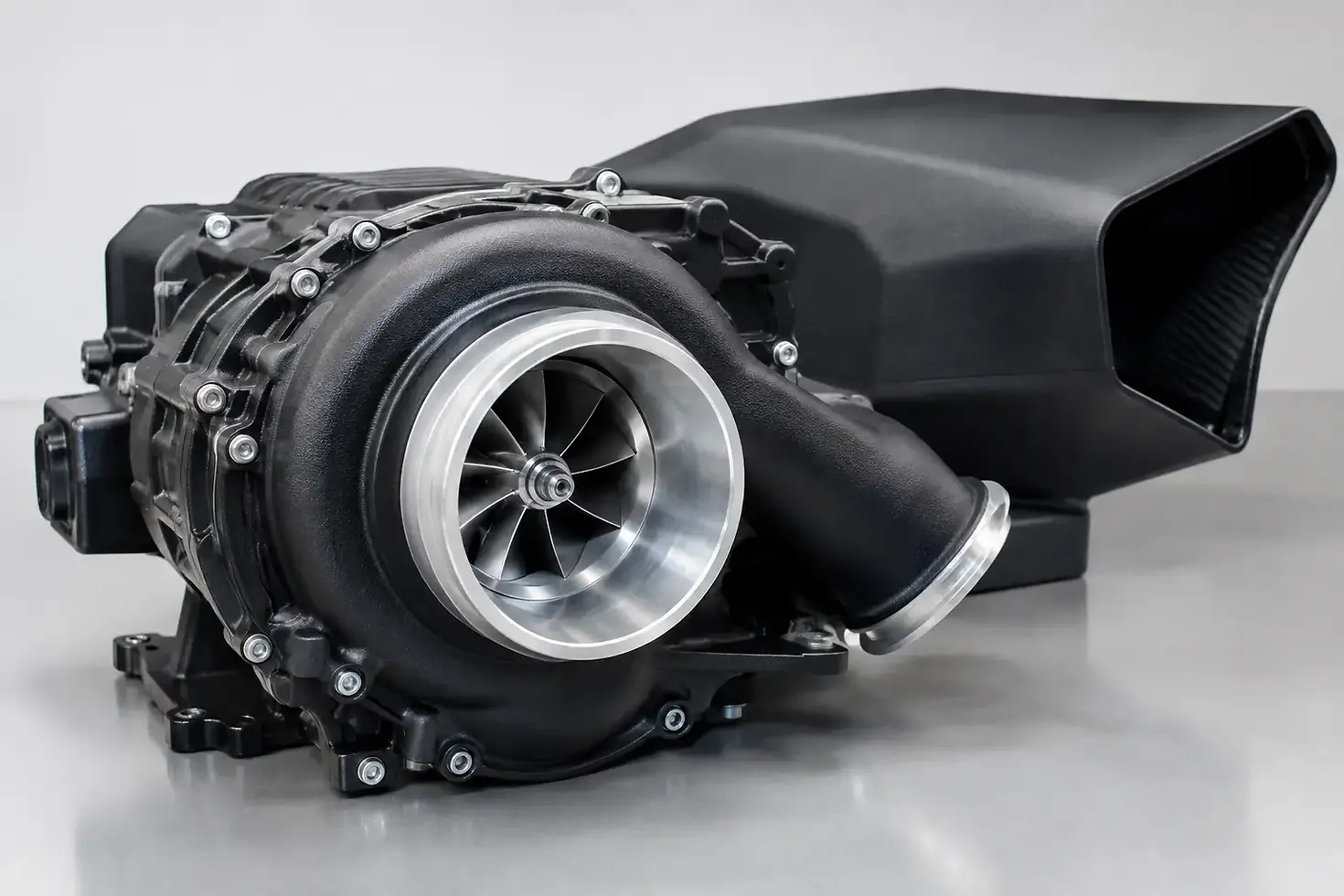
Now Shipping: ProCharger P-1R 1,200+ HP in P-1X Packaging
Now shipping - ProCharger P-1R: 1,200+ HP capability in P-1X packaging gives serious builders a compact centrifugal supercharger option with far more room to grow than its size suggests. This is not a mild street upgrade meant to live forever on a stock fuel system and a generic tune. The P-1R is aimed at combinations where airflow, belt control, charge cooling, fuel delivery, and calibration are being treated as one complete package.
For builders who already know the value of ProCharger’s compact self-contained supercharger layout, the appeal is straightforward. The P-1R brings four-digit horsepower capability into packaging associated with the P-1X family. That can matter when accessory drive space is tight, the engine bay is crowded, or a build needs serious power without moving to a physically larger blower setup.
What the ProCharger P-1R Brings to the Build
The P-1R is a centrifugal supercharger designed for high-output street, strip, and race combinations. Like any centrifugal unit, boost rises with engine speed. That means the vehicle can remain manageable at lower rpm while pulling hard through the upper part of the tachometer. On the right engine, that power delivery works especially well for drag racing, roll racing, road-course use, and high-power street cars that spend real time at wide-open throttle.
The headline number matters: 1,200+ horsepower capability. But capability is not the same thing as a guaranteed result from every vehicle. Actual power depends on the engine’s displacement, cylinder head flow, camshaft, compression ratio, fuel type, exhaust system, boost level, intercooler efficiency, and tune. A healthy modern V8, a built LS-based engine, a Coyote, or another well-supported platform may use the P-1R very differently than a small-displacement street engine with stock internals.
That is the right way to look at this blower. The P-1R gives the builder airflow headroom. Whether that headroom becomes 700 horsepower, 900 horsepower, or a four-digit number depends on the rest of the combination and how much power the engine, drivetrain, and chassis are prepared to hold.
1,200+ HP Capability in P-1X Packaging
Packaging is often the difference between a clean, serviceable installation and a project that turns into bracket fabrication, belt-alignment problems, and constant compromises. The P-1R’s P-1X-style packaging is a major part of its value. Builders can pursue substantially more airflow without automatically stepping into the bulk and installation demands that may come with a larger supercharger arrangement.
This is particularly useful on late-model engine bays where intake tubing, radiator clearance, electric fans, power steering, air conditioning, and accessory drive routing all compete for space. It also matters on classic swaps, where the engine may be sitting in a chassis that was never designed for modern high-output accessory systems.
Compact packaging does not mean the installation is simple by default. At this power level, details that are easy to overlook on a mild build become mandatory. Belt wrap, pulley alignment, bracket rigidity, bypass valve placement, intercooler plumbing, and intake-air temperature control all deserve attention. A supercharger that can support big power will expose weak installation work quickly.
The belt drive is not an afterthought
High boost and high rpm put real load on the drive system. If belt slip is present, the boost curve becomes inconsistent, power falls off, and tuning repeatability suffers. A proper setup needs correctly aligned pulleys, solid brackets, adequate belt wrap, and a tensioning arrangement suited to the intended boost and rpm range.
Builders chasing the upper end of the P-1R’s capability should plan the belt system before ordering parts, not after the engine is assembled. Hood clearance, accessory retention, crank pulley selection, and racing-class rules can all influence the right direction.
Build the Supporting System Before Turning Up the Boost
The blower is only one component in a forced-induction package. The more power the P-1R is asked to make, the less tolerance there is for weak links. A clean install starts with an honest assessment of the engine and ends with a calibration built around verified data.
Fuel system capacity is the first major checkpoint. Injectors, fuel pumps, wiring, lines, rails, regulator capacity, and fuel pressure control need to support the target horsepower with margin. Pump gas may be appropriate for a conservative street setup, while ethanol blends or race fuel can offer more detonation resistance for higher boost combinations. Each fuel choice changes the injector volume and pump capacity required.
Charge-air cooling is equally critical. Compressed air creates heat, and heat works against power and engine safety. Proper intercooler sizing, efficient airflow through the core, secure couplers, and sensible plumbing routing help keep inlet temperatures under control. A restrictive or poorly routed charge system can cost power and make the tune less forgiving.
The engine itself has to be part of the plan. A stock long block may be perfectly usable at a modest power level, but it should not be treated like a built rotating assembly with forged pistons, appropriate ring gap, quality fasteners, and cylinder heads selected for boost. There is no universal boost number that is safe for every engine. Compression ratio, fuel quality, combustion chamber design, timing control, and mechanical condition all matter.
Calibration Is Where the Combination Lives or Dies
A P-1R-equipped engine should be tuned with the same seriousness used to select the hard parts. The tune needs accurate airflow modeling, appropriate fueling under load, ignition timing suited to the fuel and charge temperature, and reliable safety strategies where the ECU supports them. Wideband oxygen data, fuel pressure monitoring, inlet-air temperature data, and boost data are not optional luxuries on a serious build. They are what lets the tuner see whether the engine is receiving what the calibration assumes.
For electronically controlled late-model platforms, tuning hardware and sensor strategy should be decided early. For standalone EFI applications, select an ECU with enough inputs and outputs to monitor the important systems and manage the engine appropriately. If a car will see drag-strip passes, long pulls, or road-course sessions, data logging is worth the effort. A quick look at logs can reveal belt slip, fuel pressure drop, high inlet temperatures, or spark-control issues before they turn into expensive parts failures.
GTPRACING’s background in engine building and dyno tuning supports the practical approach: match the supercharger to the entire combination, then verify the result. Do not build around an advertised horsepower number alone.
Who Should Choose the P-1R?
The P-1R makes sense for builders who want a compact ProCharger setup but do not want to outgrow it as the project evolves. It is a strong fit for a forged street/strip engine, a high-output late-model build, or a dedicated race application where power goals are well beyond the range of an entry-level supercharger.
It may be more supercharger than necessary for a stock-engine cruiser targeting a conservative power increase. In that case, a smaller unit can offer a better match for the budget, fuel system, traction level, and intended use. Bigger is not automatically better if the vehicle cannot apply the power or the owner has no plan to upgrade the supporting components.
For the builder who does have that plan, the P-1R offers room to keep moving. Start with a controlled, well-calibrated setup, sort out the chassis and fuel system, and leave the door open for more power when the rest of the car is ready for it.
The best supercharged builds are not defined by the biggest boost number on a gauge. They are defined by parts that work together, repeatable data, and a car that can make the pass, make the pull, and come back ready to do it again.


Comments