


Eastwood MIG Welder Review for Real Shop Work
A cheap welder can turn a simple quarter-panel patch into a war with burn-through, bird-nesting wire, and ugly cold laps. This Eastwood MIG welder review looks at these machines from the standpoint that matters: repairing thin automotive sheet metal, building brackets, welding exhaust, and putting reliable parts back on the car.
Eastwood MIG welders have earned a place in home garages and small fabrication shops because they are aimed squarely at automotive work. They are not marketed as massive industrial production machines, and that is the point. For the builder restoring a truck cab, repairing a floor pan, adding seat mounts, or fabricating race car components, the right Eastwood unit can cover a lot of ground without buying more capacity than the job requires.
Where Eastwood MIG Welders Fit
Eastwood's MIG lineup generally covers the common steps between entry-level sheet-metal repair and heavier shop fabrication. Smaller 120-volt machines are practical for bodywork and light steel. Larger 220-volt welders bring more heat, better duty cycle, and enough output for thicker brackets, frame-related work, and repeatable fabrication sessions. Multi-process machines add TIG and stick capability for shops that need more than one process without filling the floor with separate power sources.
That range matters because automotive welding is rarely one single task. A classic restoration may start with 20-gauge patch panels, move to 1/8-inch seat brackets, then need a few heavier welds on a trailer or equipment stand. Buying strictly by advertised maximum thickness is a common mistake. A welder should have enough reserve power that it is not running flat out every time thicker material hits the table.
For most bodywork-heavy projects, a compact 120-volt MIG machine is usually the sensible starting point. For a shop building suspension brackets, roll cage tabs, engine mounts, or thicker chassis fixtures, step up to a 220-volt machine. The added input power is not just about a bigger number on the dial. It gives the machine a better working range when the metal gets thicker and the welds need to be repeated all afternoon.
Eastwood MIG Welder Review: What Works Well
The strongest point is application focus. Eastwood welders are built for customers who are actually working on vehicles, not just practicing beads on coupon steel. Features such as infinitely adjustable voltage and wire-speed controls on many models are valuable because automotive steel varies wildly in thickness, condition, fit-up, and contamination. Fine adjustment lets the operator dial in a flatter, cleaner bead rather than settling for coarse preset settings.
For thin sheet metal, control is everything. A welder that can run a stable low-output arc makes plug welds, butt welds, and short stitch welds far less frustrating. That does not eliminate the need for proper panel fitment and heat management, but it gives the operator a better chance of saving the panel instead of chasing burn-through. Use clean bare metal, keep the ground clamp close to the repair, and weld in short, spaced-out stitches. No machine can compensate for welding rusty, paint-covered steel with gaps large enough to see daylight through.
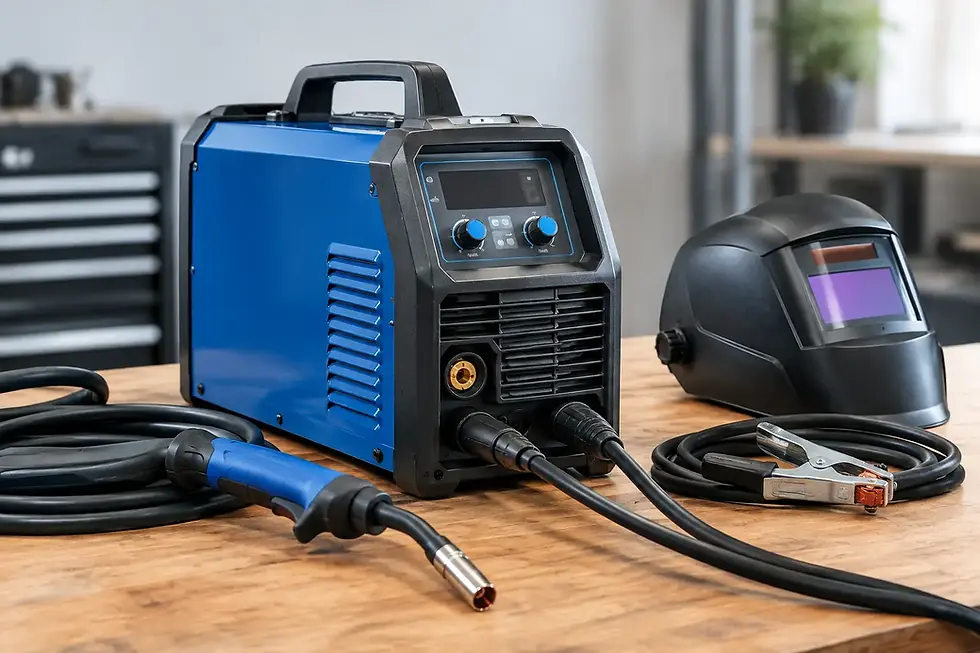
Eastwood machines also make sense for the buyer who wants a complete automotive-oriented package. Depending on the model and package, that may include a MIG gun, ground clamp, regulator, and flux-core capability. Check the current listing carefully before ordering because included accessories, spool size capacity, and consumables can vary by model. Getting the right wire, contact tips, shielding gas setup, and replacement liner at the same time prevents the project from stopping over a small missing part.
Another plus is straightforward setup. A basic MIG workflow is not complicated: install the drive roll and wire correctly, set tension without crushing the wire, connect the gas, verify polarity for solid wire or flux core, and run test coupons before touching the vehicle. Eastwood welders are approachable for that level of user, but they still offer enough adjustment to reward someone who knows how to tune an arc.
Weld Quality Depends on Setup
A fair review has to separate machine performance from operator setup. When an Eastwood MIG welder is loaded with quality wire, supplied with clean shielding gas, and tuned to the material, it can produce sound, presentable welds for restoration and fabrication work. Most complaints that sound like “the welder will not weld” trace back to polarity, bad ground placement, incorrect drive-roll tension, poor consumables, or a wire-speed setting that does not match the voltage.
For clean automotive sheet metal, solid ER70S-6 wire with a 75/25 argon-CO2 mix is the normal choice. It produces cleaner welds and less spatter than flux-core wire. Flux core has its place for outdoor repairs, heavier dirty steel, or jobs where gas coverage is impractical, but it creates more cleanup and is not the first choice for a visible body-panel repair.
Wire diameter matters, too. Smaller wire is generally easier to control on thin sheet metal, while larger wire and a larger machine are better suited to heavier material. Do not try to make one wire size handle every job just because it is already in the machine. A $20 spool of the proper wire is cheaper than a warped patch panel or a bracket with weak welds.
The Trade-Offs to Know Before Buying
Eastwood MIG welders are a strong value for restoration and enthusiast-level fabrication, but they are not automatically the right answer for every shop. If your work is production welding structural assemblies all day, every day, a heavy industrial machine with a higher duty cycle, larger wire capacity, and local commercial service support may be the better fit. That buyer needs uptime above all else.
Power availability is the other real limit. A 120-volt MIG unit is convenient because it can run where a standard outlet is available, but its output is naturally restricted. It is excellent for body panels, light brackets, exhaust work, and general repairs within its range. It is not the machine to buy if your real plan is frequent welding of thick plate, large trailer components, or substantial chassis material.
A 220-volt Eastwood MIG welder costs more upfront and requires the proper electrical circuit, but it is usually the smarter long-term buy for serious fabrication. It gives you room to grow from repair work into engine stands, fabrication tables, thicker mounting plates, and repeat bracket work. Buy based on the heaviest job you expect to do regularly, not the lightest job you can do today.
Consumable support deserves attention as well. Keep contact tips, nozzles, liners, drive rolls, and the correct replacement gun parts on hand. A worn tip or damaged liner can make even a good welder feed poorly. Shops that stay ready do not wait for a small consumable to fail before ordering replacements.
Which Eastwood MIG Welder Makes Sense?
For patch panels, rocker repair, floor pans, and light garage fabrication, start with a 120-volt Eastwood MIG model that supports gas-shielded solid wire. It is easier to store, simpler to power, and well matched to thin automotive steel.
For a builder doing regular fabrication beyond bodywork, a 220-volt MIG machine is the better tool. The added output helps with thicker steel and reduces the temptation to make multiple questionable passes because the machine lacks heat. If you also need TIG capability for stainless, aluminum, or more precise work, an Eastwood multi-process unit may be the better value than buying separate machines.
The right choice depends on your work mix. A pristine restoration shop repairing sheet metal needs control at the low end. A race car builder needs enough output for tabs, mounts, and fixture work. A small shop doing both should avoid buying too small just to save money at checkout.
Final Shop Take
An Eastwood MIG welder is a practical buy when the goal is to get automotive projects moving without sacrificing weld control. Match the machine to your available power and material thickness, set it up with the right gas and wire, and practice on the same steel before welding the actual part. Do the job right the first time, because grinding out a bad weld is never faster than making a good one.


Comments