


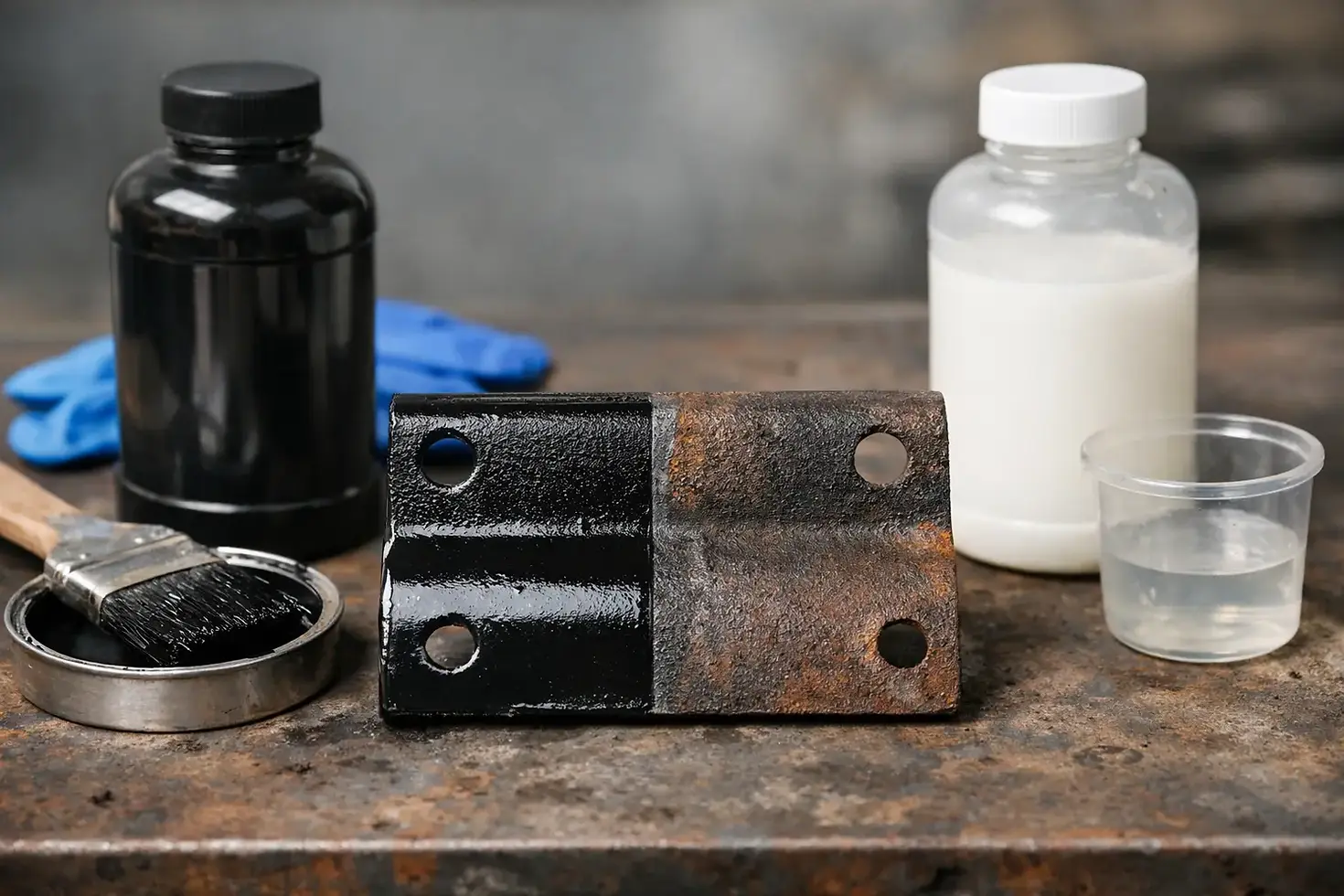
Rust Encapsulator vs Rust Converter
If you are staring at a rusty frame rail, floor pan, suspension arm, or inner fender, the wrong product choice can waste a full weekend. The real question behind rust encapsulator vs rust converter is simple: are you trying to seal corrosion that is already under control, or chemically change active rust before you coat it?
That distinction matters more than the label on the can. Both products have a place in restoration and chassis work, but they do different jobs. Use the wrong one on the wrong surface and you can end up trapping loose scale, fighting adhesion problems, or coating over rust that keeps creeping underneath.
Rust encapsulator vs rust converter - the core difference
A rust encapsulator is a coating. Its job is to isolate existing rust from air and moisture so corrosion stops advancing. Think of it as a barrier layer designed to bond to properly prepared rusty metal better than standard paint.
A rust converter is a chemical treatment. Its job is to react with iron oxide and convert it into a more stable surface that can then be primed or topcoated. It is not just paint with a better name. It is meant to change the rust itself.
That is why these products are not automatic substitutes for each other. An encapsulator works best when the rust is tight, well-prepped, and not flaking apart. A converter makes more sense when the surface still has active rust in pits and texture that you cannot fully blast or grind out, but you can remove the loose stuff.
When a rust encapsulator is the better move
If you have already done the hard part - scraping, wire-wheeling, sanding, needle-scaling, or blasting off all loose corrosion - an encapsulator is usually the cleaner solution. It is especially useful on frames, underbodies, axle housings, core supports, brackets, and other parts where you still have sound metal with surface rust staining or light pitting.
The big advantage is film build and protection. A good encapsulator leaves a durable coating that resists chips, moisture, and road abuse better than many basic primers. On parts that live underneath the vehicle, that matters.
It also fits real-world shop workflow. Once the surface is solid and prepped, you coat it and move on. For builders trying to get a chassis back together, that is often the fastest path that still gives professional results.
Where people get into trouble is treating encapsulator like a magic fix for rotten metal. It is not. If the rust is swollen, layered, or shedding scale, the coating is only sitting on top of failure. That part needs more prep, deeper rust removal, or outright patching and replacement.
Best use cases for encapsulator
Encapsulator is usually the right call on frames with solid metal and light to moderate surface rust, suspension and steering parts after mechanical cleaning, and underbody sections where blasting every pit to white metal is not practical but the structure is still sound.
It is also a strong option when you want a finish coat that can stand on its own in hidden or semi-hidden areas. Some products can be topcoated, but many are tough enough for chassis duty by themselves depending on UV exposure and the part location.
When a rust converter makes more sense
A rust converter earns its keep when rust is still active in pits, seams, and textured areas that mechanical prep cannot fully clean. It is common on floor pans, trunk interiors, battery trays, inside door shells, and seam-heavy structures where you can remove loose rust but cannot realistically grind every crater clean without thinning the panel.
In those cases, the converter can stabilize what remains. It reacts with the rust and leaves a surface that is better suited for primer and paint than untreated corrosion.
But there is a catch. Converters are prep-sensitive. If the surface is greasy, flaky, or loaded with heavy scale, the chemistry cannot do its job evenly. You still need to degrease, strip off loose material, and follow the cure window. Rush it, and the next coating may not bond the way it should.
Another thing to watch is expectation. A converter is not a structural repair. If a rocker, cab corner, or frame section is deeply compromised, chemical treatment does not put steel back into the part. It only helps stabilize remaining rust on salvageable metal.
Best use cases for converter
Converter works well when the rust is moderate, still firmly attached in pits, and the part will be primed and topcoated afterward. It is often the smart move for sheet metal with tight corrosion patterns and seam areas where abrasive access is limited.
It is less ideal when you want one heavy-duty final coating in a high-abuse zone. In that situation, a converted surface usually still needs another coating system over it.
Surface prep decides the winner
Most product failures blamed on chemistry are really prep failures. That is true whether you choose an encapsulator or a converter.
For either product, start by removing oil, road grime, wax, and any silicone contamination. Then strip away anything loose - flaking rust, lifting paint, undercoating edges, and scale. If you can knock it off with a scraper, wire wheel, abrasive disc, or blast media, it should not stay under the coating.
After that, the path splits. If the remaining rust is thin, tight, and the goal is a durable barrier coat, encapsulator is usually the better fit. If the remaining rust is still active in pores and pits and you need chemistry to neutralize it before finishing, converter is often the better choice.
This is where experienced builders save time. They stop asking which product is stronger and start asking what the metal actually looks like after prep.
Rust encapsulator vs rust converter on common automotive jobs
On a truck frame or classic car chassis, encapsulator usually wins. Those parts see impact, moisture, and road debris, so a tough barrier coating makes sense after aggressive mechanical prep.
On floor pans and trunk pans, it depends. If you have broad surface rust with shallow pitting after cleanup, an encapsulator can work well. If the rust lives deep in pinhole-prone texture and seams, a converter followed by the correct coating system may be smarter.
On suspension parts, crossmembers, and brackets, encapsulator is often the straightforward answer because these pieces benefit from a durable finish and are easier to prep thoroughly.
On body cavities, seam areas, and hard-to-reach internal structures, converter can help where tool access is limited. You still need follow-up protection, but the chemical action can buy you a more stable base.
What not to do
Do not coat over oily rust and expect either product to save it. Do not apply encapsulator over thick, scaly corrosion. Do not assume converter means zero prep. Do not skip the topcoat if the product requires one, especially in UV-exposed or high-wear areas.
Also, do not ignore metal thickness. If a panel is thin enough to flex like foil or a frame section has serious section loss, stop thinking chemistry and start thinking repair. Cut, fabricate, weld, then coat the new metal correctly.
How to choose without overthinking it
A simple rule works most of the time. If the rust is solidly attached, the part is structurally sound, and you want a durable coating layer, use an encapsulator. If rust remains deep in pits or seams after prep and you need to chemically stabilize it before primer or paint, use a converter.
There are cases where both show up in one project. You might convert rust in a seam-heavy floor section, then use an encapsulating or chassis coating on heavier underbody parts nearby. Real restoration work is not one-product-fits-all.
That is also why product families from brands like Eastwood and KBS Coatings matter. The chemistry, topcoat compatibility, and intended use are usually clearer when you stay inside systems built for automotive metal repair instead of grabbing random coatings off a hardware shelf.
The result you should be chasing
The goal is not to make rusty metal look black for a month. The goal is to stop corrosion progression and keep the part in service. That means honest prep, the right chemistry for the condition of the steel, and enough coating protection for how the vehicle will actually be used.
If your build sees wet roads, gravel, track abuse, or long storage cycles, be stricter with prep and coating choice. Rust never takes a season off. Pick the product that matches the metal in front of you, do the job right, and the repair has a real chance to last.


Comments